TOYOTA 77704-63010 Hilux Surf Canister
fits model: Gx460, Fj, Cruiser, 4runner. make: Lexus, Toyota.
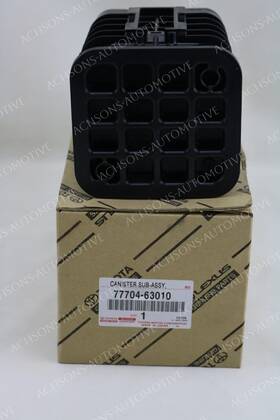
( Brand: Toyota ), ( Manufacturer Part Number: 77704-63010 ), ( Part Type: Canister ), ( Description: Canister Assy, Charcoal ), ( Manufacturer Warranty: 1 Month ), ( Vintage Part: No ), ( Country Of Origin: Japan )
Review TOYOTA Hilux Surf Lexus Charcoal Canister fits CRUISER 4RUNNER GX460 FJ
The **Toyota 77704-63010 Canister** is a high-performance, precision-engineered component designed to play a critical role in the emissions control systems of Toyota s most rugged and versatile off-road vehicles, including the **FJ Cruiser, 4Runner, Hilux, Surf, and Lexus GX460**. This canister, often referred to as an EVAP (Evaporative Emission Control) canister or charcoal canister, is a vital part of the vehicle s fuel system, tasked with capturing and storing fuel vapors that would otherwise escape into the atmosphere. Crafted from durable, corrosion-resistant materials, it is built to withstand the harshest conditions whether navigating rocky trails, crossing deep water, or enduring extreme temperatures ensuring long-lasting reliability. The canister features a robust, sealed design with a high-capacity charcoal filter that efficiently traps hydrocarbons from the fuel tank, preventing them from entering the atmosphere while maintaining optimal engine performance. Its compact yet sturdy construction allows for easy installation, fitting seamlessly into the vehicle s existing EVAP system without compromising functionality. Whether you re tackling desert dunes, mountain passes, or urban commutes, this canister ensures compliance with emissions regulations while contributing to the overall efficiency and longevity of your Toyota or Lexus off-roader. Ideal for both original equipment replacement and aftermarket upgrades, it exemplifies Toyota s commitment to balancing performance, durability, and environmental responsibility in its legendary off-road lineup.
### **Pros and Cons of Buying a Used Toyota Canister (77704-63010) for Various 4x4 Models**
The **Toyota 77704-63010** is a **fuel canister** used in several Toyota and Lexus SUVs, including the **FJ Cruiser, 4Runner, Hilux Surf, and Lexus GX460**. This part is critical for **evaporative emissions control**, storing fuel vapors and preventing them from escaping into the atmosphere. Below is a detailed breakdown of its pros and cons when purchasing a used or aftermarket replacement.
---
### **Pros of Buying a Used or Aftermarket 77704-63010 Canister**
1. **Cost Savings**
- New OEM canisters are expensive, often ranging from **$150 $300 ** depending on the model.
- Used or aftermarket units can be **30 50% cheaper**, making them a budget-friendly alternative.
- Some aftermarket brands (e.g., **Denso, ACDelco, or local auto parts stores**) offer reliable alternatives at lower prices.
2. **Immediate Availability**
- If you need a replacement quickly (e.g., for a road trip or emergency), a used or aftermarket canister may be available **same-day or within hours**, whereas OEM parts may require shipping.
- Online marketplaces (e.g., **eBay, Facebook Marketplace, Craigslist**) often have listings with fast turnaround.
3. **Compatibility with Modified or Tuned Vehicles**
- Some aftermarket canisters are designed to work better with **tuned engines** (e.g., turbocharged or high-performance setups) where stock canisters may fail prematurely.
- Certain brands offer **larger or reinforced canisters** that reduce clogging in high-mileage or modified vehicles.
4. **Environmental Compliance**
- Replacing a failing canister prevents **emissions system failures**, which could trigger a **check engine light (CEL)** and potential **failing an emissions test**.
- A functional canister ensures the vehicle meets **local emissions regulations**, avoiding fines or registration issues.
5. **Prevents Long-Term Damage**
- A clogged or leaking canister can cause **fuel pressure issues**, **rough idling**, or **reduced engine performance**.
- Replacing it early avoids **costlier repairs** to the **fuel system, EVAP system, or even the catalytic converter** if left unaddressed.
6. **Easy Installation (DIY-Friendly)**
- The canister is relatively simple to replace most owners can do it in **under an hour** with basic tools.
- No special equipment is required, making it a **cost-effective DIY project**.
---
### **Cons of Buying a Used or Aftermarket 77704-63010 Canister**
1. **Reliability Concerns with Used Parts**
- **Unknown history**: A used canister may have been **dropped, crushed, or exposed to extreme temperatures**, reducing its lifespan.
- **Potential leaks or cracks**: Even if it looks fine, internal damage (e.g., from corrosion or impact) may not be visible until installation.
- **Mixed-quality sources**: Some sellers on online marketplaces may not disclose **previous damage or improper storage**, leading to premature failure.
2. **Risk of Counterfeit or Low-Quality Aftermarket Parts**
- Some aftermarket canisters are **cheaply made**, leading to:- **Early clogging** (especially in high-mileage or modified vehicles).
- **Leaks** over time, causing **fuel odor or emissions issues**.
- **Poor sealing**, resulting in **false EVAP system errors**.
- **No warranty**: Unlike OEM parts, aftermarket canisters often come with **limited or no warranty**, leaving you responsible for replacements if they fail quickly.
3. **Potential Emissions Test Failures**
- If the canister is **not properly sealed or functional**, the vehicle may **fail an emissions test** even after replacement.
- Some aftermarket parts may not meet **strict emissions standards**, leading to **additional repairs or retests**.
4. **Incompatibility with Certain Modifications**
- **Turbocharged or high-flow fuel systems** may require a **larger or reinforced canister** some aftermarket options may not handle the increased vapor load.
- **Aftermarket fuel injectors or ECU tunes** can sometimes cause **EVAP system errors** if the canister is not compatible.
5. **Limited Longevity in Harsh Conditions**
- **Extreme heat or cold** can degrade plastic canisters faster than OEM parts.
- **Off-road use** (e.g., in the **4Runner or Hilux Surf**) exposes the canister to **dirt, water, and vibrations**, which may accelerate wear in a used or low-quality part.
6. **Difficulty in Verifying Authenticity**
- **Fake OEM parts** are sometimes sold as genuine, leading to **poor performance or failure**.
- **No easy way to test** a used canister before purchase you must rely on the seller s description, which may be unreliable.
---
### **Comparison of Options**
**Option** **Pros** **Cons**
------------ ---------- ----------
**New OEM Canister** - Guaranteed compatibility - Full warranty - Longest lifespan - Expensive - Shipping delays possible
**Used Canister (from trusted source)** - Cheaper - Quick availability - Unknown history - Risk of damage - No warranty
**Aftermarket Canister (reputable brand)** - Cost-effective - Often better for modified vehicles - Some warranties available - Quality varies - May not meet emissions standards - Risk of early failure
**Remanufactured Canister** - Tested and refurbished - Often cheaper than OEM - Some warranty coverage - Limited availability - May not be as durable as new
---
### **Conclusion & Recommendation**
#### **Best Choice Depends on Your Situation:** 1. **If you need a quick, budget-friendly fix and trust the seller:**- A **used canister from a reputable source** (e.g., a local auto parts shop with a return policy) can be a good option if you **inspect it for damage** before purchase.
- **Avoid buying blindly from online marketplaces** unless the seller provides **clear photos, a warranty, or a return policy**.
2. **If you want reliability and long-term performance:**- **Buy a new OEM canister** (or a **high-quality aftermarket brand like Denso or ACDelco**) for **peace of mind** and **full warranty coverage**.
- If cost is a concern, look for **remanufactured OEM parts**, which are often **tested and refurbished** at a lower price.
3. **If your vehicle is modified or tuned:**- **Avoid cheap aftermarket canisters** opt for a **larger, reinforced canister** (e.g., **Toyota #77704-63010 or an upgraded aftermarket model**) to prevent **clogging or leaks**.
- Consider **upgrading the entire EVAP system** if you frequently modify fuel delivery.
4. **If you re unsure about the canister s condition:** - **Test the EVAP system** before buying a used part:- Check for **leaks** (listen for hissing near the canister).
- Scan for **emissions-related codes** (e.g., **P0440, P0442, P0455**) if they persist after replacement, the issue may be elsewhere.
- **Replace associated hoses and seals** if the canister is old, as they may also be worn.
---
### **Final Recommendation:**- **For most owners (especially on stock vehicles), the best balance is a new OEM or high-quality aftermarket canister** it ensures **reliability, warranty coverage, and compliance with emissions standards**.
- **If you re on a tight budget and can verify the used part s condition**, a **used canister from a trusted source** can be a **cost-effective stopgap**, but **expect to replace it sooner rather than later**.
- **For modified or high-mileage vehicles**, **prioritize a reinforced or larger canister** to prevent **premature failure** and **EVAP system errors**.
- **Always inspect the canister for cracks, leaks, or damage** before installation, and **replace related hoses and seals** if they show signs of wear.
**Best long-term solution:** **New OEM or a well-reviewed aftermarket canister** (e.g., **Denso, ACDelco, or Toyota Genuine**) with a **full warranty** to avoid future issues.
Details:
Quality, Speed, and Service. You pay only item cost shipping. Fast and free shipping. The part must be installed properly and not disassembled to qualify.
Warranty: 30-day limited warranty included.
part #: 7770463010 prices
- $49.99-$152.00
specifications emissyste:
- for models: Gx460, Fj, Cruiser, 4runner
- for makes: Lexus, Toyota
- brand: Toyota
- mpn: 77704-63010
- part type: Canister
- description: Canister Assy, Charcoal
- manufacturer warranty: 1 Month
- vintage part: No
- country of origin: Japan
seller emissyste:
- rating: 100.0%
- city: Shirley, New York
- # reviews: 3357
offer emissyste:
- options: Ship-to-home
- sold: 0
- quantity: 1
- availability: In Stock
- started: February 24, 2026
returns emissyste:
- time: 30 Days
- paid by: Seller
- policy: Returns Accepted
payments emissyste:
- other
- credit card: Visa
- wallet: Google-pay
general emissyste:
- condition: New
- Car Truck Parts Accessories > Exhaust Emission Systems > Other Exhaust Emission Parts
shipping emissyste:
- transit: 8-14 Days
- type: Fixed
- service: Standard
- class: Standard
- cost: $0.00
Toyota 77704-63010 Is Similar To:
- 12204-20040 Lexus Toyota Oem Genuine Pcv Valve (27.4% similar) ...(October 10th, 2018)
- 12261-46051 Lexus Toyota Oem Genuine Pcv Valve Vacuum Hose (19.1% similar) ...(October 10th, 2018)
- 12261-50040 1226150040 Toyota Factory Lexus Pcv Ventilation Hose Oem (26% similar) Part number, why settle for aftermarket. When you can have the factory genuine oem at a fraction of cost...(December 27th, 2018)
- 184600-1960 Toyota Runner Charcoal Evap Emissions Vapor Canister (42.3% similar) ...(September 18th, 2018)
- 22240-02130 Toyota Corolla Fuel Vapor Charcoal Canister (48.1% similar) This will come with a 30 day warranty. You are buying a used hatch lock actuator. If there was a dispute will check the messages in only to make their final decision. The part must be fully checked before messaging us through only. Condition of the parts:all parts are in working order, and tested ...(March 14th, 2018)
- 22240-02131 Toyota Corolla Fuel Vapor Charcoal Canister (48.1% similar) Warranty:each part comes with a warranty. Part numbers must match. If there was a dispute will check the messages in only to make their final decision. You are buying a used hatch lock actuator. The part must be fully checked before messaging us through only. This will come with a 30 day warranty. ...(July 23rd, 2018)
- 23818-46110 Toyota Genuine Lexus Pipe Fuel Vapor Feed Oem (34.1% similar) Please if item is found defective or wrong. And you can take the item to ups FedEx USPS drop off location return us. With FedEx ups to us. Delivery confirmation number is available. Ak, hi, GU, vi, mp. . USPS FedEx ups ground: regular size items over 2 lbs. Domestic pr, hi, ak, GU, vi, APO, FPO, PO...(March 9th, 2019)
- 25620-37120 Toyota Lexus Toyota-lexus 2562037120 (25.4% similar) ...(July 10th, 2017)
- 25620-66011 Toyota Lexus Toyota-lexus 2562066011 (25.4% similar) Many series land cruisers parts. Ask any and all questions before buying. Used condition. Please see pics. I'll be posting more parts as time comes. No hardware...(December 8th, 2017)
- 25701-38131 Toyota Lexus Air Switching (25.9% similar) Please verify fitment with a Toyota lexus dealer before purchase. No testing has been performed. Ask all questions prior to buying. Shipping and packaging for this item is. Most by FedEx,USPS or ltl carrier. What you see in the pictures is will receive unless specified. They are in very good ...(July 24th, 2017)
- 2570120150 Toyota Vapor Canister Purge (31% similar) Superseded part numbers this item may have been from a different number manufacture...(June 19th, 2017)