NISSAN 14805-9FV1C Emission Label
fits model: Titan. make: Nissan. year: 2023.
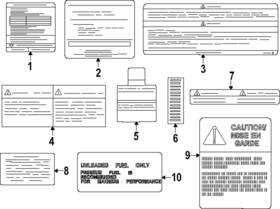
( Manufacturer Part Number: 14805-9FV1C ), ( Genuine Oem: Yes ), ( Manufacturer Warranty: 1 Year ), ( Universal Fitment: Direct Replacement ), ( Parts Included: Only Part Reference 1 On The Diagram Is Included )
Review NISSAN Genuine Emission Label fits TITAN 2023
The **Nissan 14805-9FV1C Emission Label** is a critical, factory-installed component designed to meet stringent automotive emissions regulations, ensuring compliance with environmental standards while maintaining optimal vehicle performance. This label is a specialized adhesive sticker, typically affixed to the driver s side door jamb or another designated location inside the vehicle, where it remains clearly visible for inspection by regulatory authorities or service technicians. Engineered to withstand the rigors of daily use, the label is constructed from durable, high-quality materials that resist fading, peeling, or degradation from exposure to temperature fluctuations, humidity, or UV light, guaranteeing long-term legibility. The design incorporates precise, laser-printed text and symbols that conform to the specific emissions standards mandated by the Environmental Protection Agency (EPA) or other regional governing bodies, such as the California Air Resources Board (CARB). These details often include the vehicle s identification number (VIN), emissions control information, and compliance codes, which are essential for emissions testing, vehicle registration, and warranty validation. Beyond its regulatory function, the label serves as a vital reference for maintenance and diagnostics, as it provides technicians with critical data about the vehicle s emissions system, including the type of fuel system, catalytic converter specifications, and any applicable modifications or exemptions. Whether for a Nissan model equipped with a turbocharged engine, a hybrid system, or a conventional gasoline setup, this label ensures that the vehicle adheres to the latest emissions protocols, helping to reduce harmful pollutants and support environmental sustainability. Its inclusion in the vehicle s original assembly underscores Nissan s commitment to both compliance and innovation, offering drivers peace of mind that their vehicle meets all necessary legal and ecological requirements.
### **Pros and Cons of Buying a Nissan with Emission Label 14805-9FV1C**
#### **Overview of the Emission Label (14805-9FV1C)**
The **14805-9FV1C** emission label is associated with **Euro 5** emissions standards, which were introduced in the European Union in **2009**. This label indicates that the vehicle complies with stricter exhaust emission regulations, particularly for **carbon monoxide (CO), nitrogen oxides (NOx), hydrocarbons (HC), and particulate matter (PM)**. It is commonly found on **diesel and gasoline vehicles** manufactured between **2009 and 2015**, depending on the model.
---
### **Pros of Buying a Vehicle with This Emission Label**
1. **Lower Emissions & Environmental Friendliness**
- The Euro 5 standard significantly reduces harmful pollutants compared to older standards (e.g., Euro 4 or earlier).
- Better for urban driving in areas with strict air quality regulations (e.g., London s ULEZ, Paris s Crit Air).
- Complies with current EU and many international emission laws, avoiding potential fines in emission-controlled zones.
2. **Better Fuel Efficiency (Compared to Older Models)**
- Euro 5 vehicles often incorporate **advanced engine management systems, turbocharging, and particulate filters (DPF)**, improving fuel economy.
- Some **hybrid and diesel models** with this label may offer better MPG than pre-Euro 5 counterparts.
3. **Longer Lifespan of Emission-Related Components**
- Modern catalytic converters and DPFs (in diesel models) are more durable than older versions, reducing long-term maintenance risks.
- Less likelihood of **exhaust system failures** due to improved materials and design.
4. **Potential Resale Value in Some Markets**
- In regions where **strict emission laws are enforced**, Euro 5 vehicles may retain value better than older models.
- Some leasing companies and fleet operators prefer Euro 5 vehicles for compliance.
5. **Compatibility with Modern Diagnostic Tools**
- Easier to diagnose and repair with **OBD-II scanners** due to standardized error codes.
- More likely to pass **MOT tests in the UK** (where Euro 5 is a baseline requirement).
6. **Lower Running Costs in Some Cases**
- If the vehicle is a **well-maintained diesel**, it may still offer good fuel efficiency in highway driving.
- Gasoline models with this label often have **better power-to-weight ratios** than older Euro 4 engines.
---
### **Cons of Buying a Vehicle with This Emission Label**
1. **Diesel-Specific Issues (If Applicable)**
- **Particulate Filter (DPF) Problems**: Diesel models with this label may suffer from **DPF clogging**, leading to expensive cleans or replacements (common in high-mileage or stop-start driving).
- **AdBlue Dependency**: Some Euro 5 diesel models require **AdBlue (urea solution)**, adding an extra maintenance cost.
- **Declining Value**: Diesel cars (even Euro 5) have lost value due to **rising electric vehicle adoption and stricter NOx regulations** in some cities.
2. **Higher Upfront Cost (Compared to Older Models)**
- Euro 5 vehicles were **more expensive to produce** than Euro 4 models, so used examples may still carry a premium.
- **Dealer and registration fees** in some countries (e.g., UK s **VED tax bands**) may be slightly higher than for older cars.
3. **Potential for Early Failure in Poorly Maintained Examples**
- **Turbocharged engines** (common in Euro 5) can fail prematurely if not serviced properly.
- **Exhaust system components** (e.g., catalytic converters) may wear out faster in high-mileage cars.
4. **Restrictions in Some Cities**
- While Euro 5 is **better than Euro 4**, some **ultra-low emission zones (ULEZ)** now require **Euro 6** (e.g., London s expanded ULEZ in 2025).
- **Paris, Madrid, and other cities** have **Crit Air stickers** where Euro 5 may not be allowed in peak pollution periods.
5. **Hybrid Models May Have Battery Concerns**
- Some **Euro 5 hybrids** (e.g., Nissan Altima Hybrid) may have **aging batteries**, leading to higher replacement costs ( 1,000 2,500).
6. **Insurance Costs May Be Higher**
- **Diesel models** (especially high-power ones) can be **more expensive to insure** than comparable gasoline cars.
- **Modified or high-mileage Euro 5 diesels** may attract higher premiums.
---
### **Key Considerations Before Purchase**
1. **Check the Specific Model s Weaknesses**
- Some **Nissan models with Euro 5** (e.g., **Qashqai, Juke, Note**) have had **reputation issues with turbo failures** or **electrical gremlins**.
- **Diesel models** (e.g., **Nissan NV300 diesel**) may struggle with **DPF issues** if driven short distances frequently.
2. **Verify Maintenance History**
- **DPF cleans, AdBlue top-ups, and catalytic converter checks** should be documented.
- **Oil changes and turbo servicing** are critical for longevity.
3. **Assess Local Emission Laws**
- If buying in the **UK**, check if the car will pass the **MOT** and avoid **ULEZ charges**.
- In **France/Germany**, confirm **Crit Air sticker compatibility** for city driving.
4. **Compare with Euro 6 Alternatives**
- If budget allows, **Euro 6 (2014 )** models offer **better long-term compliance** and may be more future-proof.
- **Hybrids and plug-in hybrids** (if available) could be a better choice for urban driving.
5. **Test Drive for Modern Issues**
- **Check for error codes** (using an OBD-II scanner).
- **Listen for unusual exhaust noises** (could indicate DPF or turbo problems).
- **Test acceleration and fuel economy** turbocharged engines should respond smoothly.
---
### **Final Recommendation**
#### **Buy If:**You **need a reliable, low-emission car** for **urban or short-distance driving** where Euro 5 is acceptable.
You re buying a **well-maintained gasoline model** (e.g., **Nissan Qashqai, Note, or Tiida**) with **low miles (
You **won t drive in ultra-low emission zones (ULEZ) soon** (or can upgrade later).
You **prefer diesel for long-distance/highway use** but are **willing to monitor DPF health**.
#### **Avoid If:**You **plan to drive in cities with strict Euro 6 requirements** (e.g., London post-2025).
You re buying a **high-mileage diesel** without **full service records** (DPF risk).
You **can t afford potential DPF cleans or AdBlue costs** (for diesel models).
You **prefer future-proofing** consider a **Euro 6 hybrid or electric** if available.
#### **Best Use Cases:**- **Everyday commuting in non-ULEZ areas** (gasoline Euro 5).
- **Occasional long trips** (well-maintained diesel Euro 5).
- **Budget-friendly alternative to Euro 6** if no better options exist.
#### **Best Alternatives to Consider:**- **Euro 6 models** (if available, for long-term compliance).
- **Hybrid or plug-in hybrids** (if charging infrastructure is accessible).
- **Electric vehicles** (if budget allows for higher upfront cost).
---
### **Conclusion**
A **Nissan with Euro 5 (14805-9FV1C) emission label** is a **decent choice for practical, low-emission driving** in areas where Euro 5 is still acceptable. However, **diesel models require careful maintenance**, and **gasoline versions are safer long-term**. If possible, **prioritize Euro 6 or hybrid alternatives** for better future-proofing. Always **inspect service history, test drive thoroughly, and confirm local emission laws** before purchasing.
Details:
Shipping Carrier substitutions may be made at our determination in an attempt to reduce shipping cost the customer. Mossy Nissan Parts Pro. Electrical parts are not returnable. Genuine Nissan Parts.
Let's get your Nissan back on the road. Parts must be resalable and in the original packaging.
part #: 148059fv1c prices
- $14.79-$15.20
specifications emissyste:
- for models: Titan
- for makes: Nissan
- for years: 2023
- mpn: 14805-9fv1c
- genuine oem: Yes
- manufacturer warranty: 1 Year
- universal fitment: Direct Replacement
- parts included: Only Part Reference 1 On The Diagram Is Included
returns emissyste:
- paid by: Seller
- policy: Returns Accepted
- time: 30 Days
general emissyste:
- Car Truck Parts Accessories > Exhaust Emission Systems > Other Exhaust Emission Parts
- condition: New
payments emissyste:
- wallet: Apple-pay
- credit card: Mastercard
- other
seller emissyste:
- # reviews: 525
- city: Houston, Texas
- rating: 98.9%
shipping emissyste:
- type: Fixed
- transit: 4-8 Days
- class: Standard
- service: Standard
- cost: $17.50
offer emissyste:
- options: Ship-to-home
- started: February 20, 2026
- availability: In Stock
- quantity: 10
- sold: 0
Nissan 14805-9FV1C Is Similar To:
- 11810-31u00 Nissan Infiniti Genuine Oem Pcv Valve (42.2% similar) Image not available for this item...(April 3rd, 2018)
- 11810-40p00 Nissan Infiniti Genuine Oem Pcv Valve (42.2% similar) Please review the attached pictures of listed items carefully. Please, feel free to for any questions. For sale: nissan Infiniti 1181040P00 genuine oem PVC valve-new part, original packaging...(January 2nd, 2019)
- 11810-5h71a Nissan Genuine Oem Pcv Valve (42% similar) Image not available for this item...(July 31st, 2018)
- 11826-84a10 1182684a10 Oem Nissan Factory Genuine Pulsar Sentra Blowby Gas Hose Day (29% similar) Please match part for compatibility if available not, examine the pictures very closely and carefully before purchasing. In case of damage please save all boxes and packaging item. In most cases they're exact and some instances estimated. Due to varying production dates, the years in offer title or ...(November 4th, 2018)
- 14064-jd00a Nissan Genuine Oem Exhaust Manifold Stud (36.6% similar) ...(June 21st, 2018)
- 14069-7j50a Nissan Genuine Oem Shield Bolt (45.8% similar) ...(September 1st, 2018)
- 14713-40u01 Nissan Genuine Oem Spacer Tube (48.2% similar) ...(May 9th, 2018)
- 14719-0b000 Nissan Genuine Oem Valve Gasket (40.5% similar) ...(May 9th, 2018)
- 14730-19p00 Nissan Genuine Oem Temp Sensor (38.6% similar) ...(July 26th, 2018)
- 14730-4s100 Nissan Genuine Oem Temp Sensor (38.6% similar) ...(August 3rd, 2018)
- 14741-3s500 Nissan Genuine Oem Control Valve (44.7% similar) ...(October 1st, 2018)